
Reviews have become one of the clearest places where higher education brands can lose control of the narrative in AI search. Institutions can control their website, campaigns, admissions materials, and owned messaging. They can’t control every student, alumni, parent, or community perspective that AI systems collect, summarize, and surface. That tension is exactly why online reviews need to become a core part of higher education marketing strategy, not a side channel that teams monitor only when something goes wrong.
Once upon a time, when it came to reviews about your school, your star rating was all that mattered. As long as it was above average, the overall opinions about your school seemed good enough, right? Well, good enough is no longer good enough, and that’s due, in large part, to the way search has quickly evolved over the last several months. And what’s at the root of that swift change? Large Language Models (LLMs).
These LLMs are most commonly know as ChatGPT and Gemini, and they also power AI-driven search results when searching for a school that provides the classes, majors, certifications, or licenses you need to pursue your dream career.
The increasing challenge for schools is around how AI search takes fragmented review content from the web and turns it into a narrative before your institution has a chance to shape the conversation. That creates a new reputational risk: not bad reviews alone, but uncontrolled interpretation at scale.
Because of this new, ever-evolving search experience, students are finding everything they want and need to know about your educational institution. As soon as they hit “enter” on their search, they are greeted with a plethora of AI-driven answers, long before they even consider going to your website.
And what is at the forefront of that search experience when they search for your school? Reviews, reviews, and more reviews. They’re everywhere.
This is what higher education marketers need to adapt to. Let’s explore how reviews are constantly being pulled into the search journey, summarized into student-facing takeaways, and used to help AI systems explain whether your school feels credible, supportive, and ultimately, worth considering.
Jump To:
AI search turns many sources into one reputation
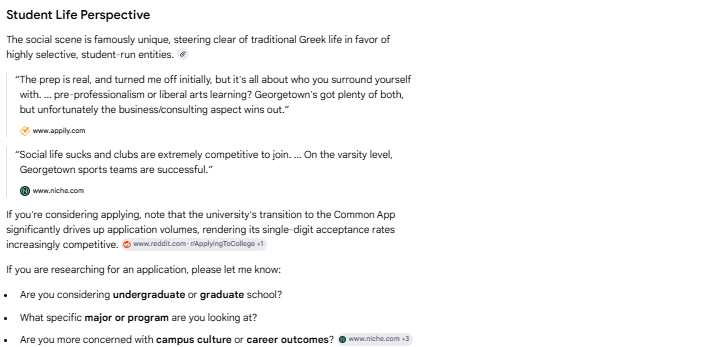
Let’s use Georgetown University as an example.
An online search for “Georgetown University reviews” will surface feedback from multiple review platforms, and AI combines that information into a summary of experiences.
Potential sources often include:
- Niche
- Yelp
- GradReports
- Tripadvisor
- School-owned review content
- Other trusted third-party sites
The shift is that whether you’re a prestigious university, a local trade school, a small liberal arts college, or somewhere in between, you can no longer focus exclusively on one review platform. Your school’s reputation is increasingly being assembled from multiple sources simultaneously. As a result, prospective students no longer have to seek out individual review sites to learn what students think about your school; they’re now seeing a blended reputation profile that presents in seconds.
In this case, our search for Georgetown University’s reviews in AI Mode immediately surfaced neatly categorized results that included, Major Advantages (Pros), Frequent Complaints (Cons), and Student Life Perspective.

And that’s just the beginning. Suppose a prospective student wants to learn more about the area where your school is located: they just might click into Google Maps to see the lay of the land.
Google Maps isn’t just for directions
When you search for a school in Google Maps, reviews are there too. Using the University of Tennessee as an example, you can see the average star rating in a bar graph that compares ratings from 1-5. Just below that, you can easily dig in further: specific keywords left in reviews are not only front and center but also clickable, ushering you straight to the reviewer’s feedback.
You can also view reviews with a filter by your preference of newest, lowest, highest, or most relevant.

Ask Maps: the new experience and how it impacts the decision-making process
Google rolled out Ask Maps in early 2026, and when used by prospective students and families wanting to learn more about a school, it can be hugely impactful on the decision-making process.
Google explains, “Ask Maps is a Gemini-powered AI conversational tool in Google Maps. Instead of typing standard keywords, you can ask natural-language questions (e.g., “Where can I work on my laptop and eat a vegan lunch?”) to receive highly personalized, synthesized recommendations complete with an interactive map.”
Put yourself in the shoes of a prospective student who might want to learn more about the schools they’re considering, perhaps to see things to do, nearby shopping, and restaurants in close proximity to the school. In this case, we used National Polytechnic College as an example.
What do we see in Ask Maps? Reviews are still prominent.
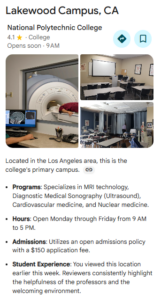
An AI-curated section titled “Student Experiences” says “Reviewers consistently highlight the helpfulness of the professors and the welcoming environment.”
The rise of conversational local search
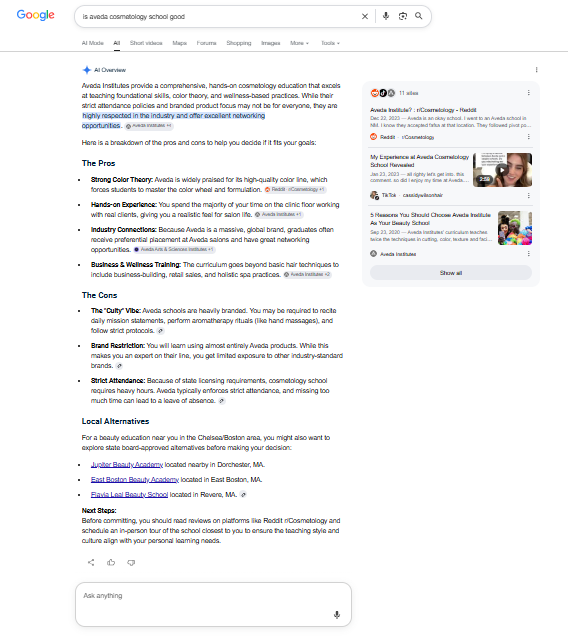
When you think of traditional search, keywords are the driving force behind how a school appears in search results. The AI-driven search experience is different, and reviews are being pulled into the mix. Reviews now power direct questions, like “Is Aveda’s cosmetology school good?”
Here’s how the AI-driven journey unfolded. Not only were Pros and Cons presented in a quick, easy-to-read bullet-point format, but we were also presented with local alternatives to Aveda. Competitors being surfaced without a prompt was extremely telling.
While AI Overviews still have a long way to go, the experience felt eerily similar to Google’s “People also search for” at the bottom of Knowledge Panels, and its “People Also Ask” features in traditional search results. However, with this experience, it seems more proactively positioned, as if to say, “If that school you’re considering is giving you what you need, perhaps these other ones will.”
The takeaway is clear: Google is using what is published online about your school – from your website and other sources – to gain a strong understanding of which majors, degrees, trainings, certifications, licenses are offered, and what the experience is like for students who have been there. As AI-powered search experiences continue to evolve, all schools – no matter the size – will need to put their best foot forward by ensuring their digital presence provides complete, accurate, and compelling answers to a wide range of questions wherever search engines and LLMs source information. Every optimization becomes an opportunity to be included in the consideration set before a student ever clicks through to a website.
Just below the option to look at competitors, we were encouraged by AI to take the “Next Steps: Before committing, you should read reviews on platforms like Reddit r/Cosmetology and schedule an in-person tour of the school closest to you to ensure the teaching style and culture align with your personal learning needs.”

So, we took the next steps, dug into AI Mode more, and asked, “What are reviews like from students that attended Aveda’s cosmetology school?”
Once again, we were served up answers in a similar bullet point format, this time organized as Positives, Negatives, and then sources where we could see this review feedback for ourselves from a variety of platforms: Reddit, TikTok, and GradReports.
No matter where the AI-search journey took us, we found evidence of feedback, sentiment, reviews, thoughts, feelings, and experiences at every turn.
The role of reviews with ads
While AI-driven search may seem totally organic, there’s no doubt that it is also a key opportunity to layer in even more intentional online visibility by way of paid media – like Google Ads, ChatGPT ads, and even Apple Maps Ads. Apple says the latter is coming in Summer 2026, ChatGPT rolled out ads in early 2026, and we’ve all seen the Google Ads in the Local Pack, at the top (or bottom) of the search results, and now ads are showing in AI Overviews.
While our efforts for the purpose of this blog didn’t produce any ads on desktop, a search on mobile for “best trade schools near me” showed the sponsored ad below for Lincoln Tech:
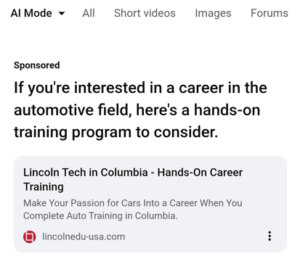
Just above that sponsored ad was this list of nearby schools, showing – you guessed it – their reviews. By investing in Ads, Lincoln Tech didn’t miss the opportunity to appear in AI Overviews, even though they didn’t land there organically.
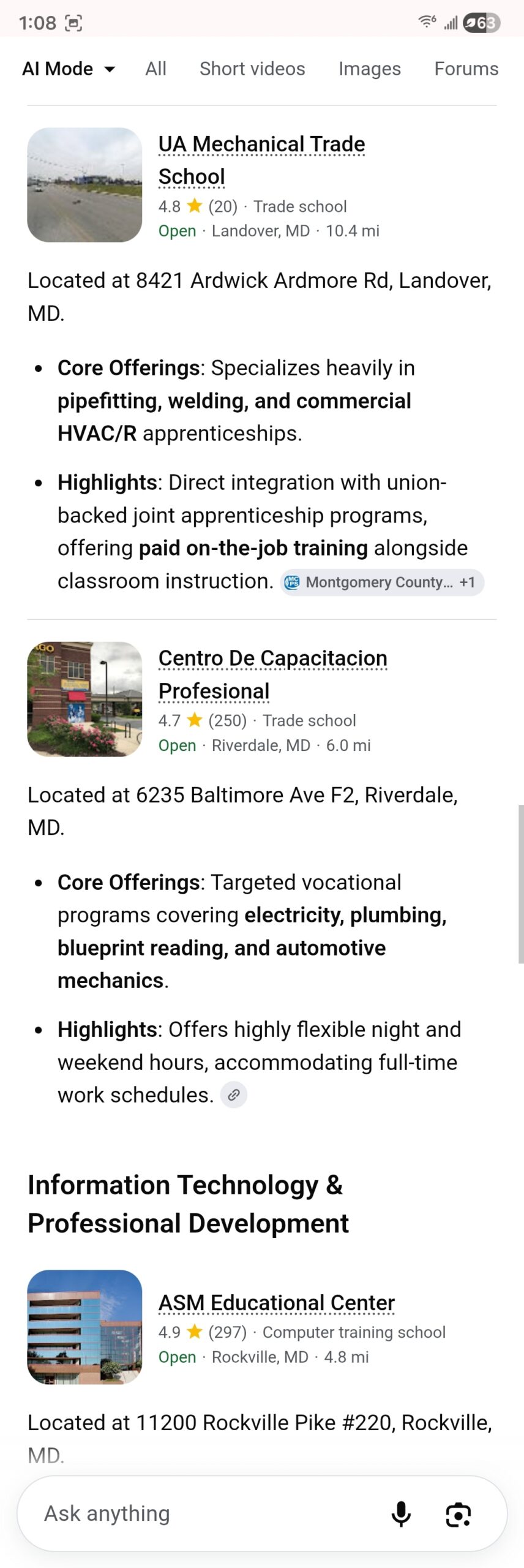
Lincoln Tech’s ad didn’t show a review star rating; however, it’s likely only a matter of time before the review visibility playing field is leveled with ads in AI Mode. Why? Because review star ratings currently show with Google’s Local Services Ads in the Local Map Pack, and in Google Maps, and that’s pulled directly from Google Business Profile. It’s not unreasonable to think that ads in AI Mode will likely follow suit and include review star ratings there too.
Also worth noting: Unrelated to education – other local internet queries are pulling in ads from other directories when in AI Mode. For example “tree removal near me” surfaced an ad from Angi – a paid listing directory for home services.

The ads above are answers to questions users might start to wonder about as their customer journey moves through each search query. What’s more: they don’t even have to search to find it. The answer is placed before them, front and center, avoiding the need to do another search.

Reviews & AI-driven search are here to stay—and will continue to evolve
When it comes to online reviews, they can either be a liability or a valuable asset. The reality is that AI is fundamentally changing how prospective students research schools. AI-powered search experiences are surfacing reviews, organizing them into easy-to-digest summaries, making recommendations, offering comparisons, and even encouraging users to explore competing institutions.
As a result, the institutions that actively manage their online reputation will have greater influence over how AI describes them. For higher education marketers, it’s no longer enough to simply monitor reviews and hope for the best. It’s essential to understand how AI platforms present your institution and to take a proactive approach to shaping that narrative.
Here are a few ways to get started:
Centralize review management.
Use a platform that aggregates reviews from multiple sources into a single dashboard, making it easier to monitor and respond without jumping between sites.
Address negative feedback thoughtfully.
When a review highlights a legitimate concern, consider reaching out to the reviewer when appropriate and work to resolve the underlying issue. A well-handled complaint can demonstrate accountability and improve perception.
Monitor reviews beyond Google.
AI-powered search tools increasingly pull information from a variety of sources, including Niche, Yelp, GradReports, Tripadvisor, and others. Your reputation extends well beyond your Google Business Profile.
Develop a review acquisition strategy.
Encourage students, alumni, and other stakeholders to share their experiences across multiple review platforms. More authentic reviews provide a richer picture of your institution and give AI systems more information to work with.
Respond consistently.
Engaging with reviews in a timely manner shows prospective students that your institution listens, values feedback, celebrates successes, and takes concerns seriously.
Reviews are no longer just a measure of reputation. They are increasingly becoming a source of information that AI uses to explain, compare, and recommend schools. The institutions that recognize this shift and adapt accordingly will be better positioned to influence the conversations AI has with prospective students.
Curious about how AI search is impacting your local prospective students? Join us for our upcoming webinar, The New Local Advantage: How AI Search Is Reshaping Student Discovery and Enrollment, or let’s talk about achieving more for your marketing and your business.