
As Google embeds AI across search, media, creative, commerce, and measurement, performance advantage will depend less on manual campaign execution and more on the quality of a brand’s signals, expertise, creative systems, and measurement infrastructure.
That shift matters for every advertiser, but it is especially important for brands in complex, high-consideration categories. When people are making decisions about their health, education, finances, insurance coverage, or future plans, they are not just looking for a product. They are looking for confidence. They need clear information, trusted expertise, relevant proof, and a brand experience that helps them move from uncertainty to action.
Google Marketing Live 2026 made one thing clear: AI is no longer just optimizing campaigns. It is becoming the connective tissue between how people search, compare, evaluate, engage, and convert.
But beneath the product announcements was a more important message for marketers: Execution is becoming easier. Differentiation is not.
Google said it plainly:
“Execution is becoming a commodity and will no longer be a competitive advantage. Because when the technical side becomes easier for everyone, your true edge comes back to what only you can provide. Your strategy.”
That statement should fundamentally change how brands think about growth.
When every marketer has access to increasingly similar AI tools, optimization engines, and generative creative capabilities, advantage shifts upstream. It moves into the quality of the data AI can learn from, the clarity of the brand it is representing, the usefulness of the content it can draw from, the strength of the creative system it can adapt, and the reliability of the measurement infrastructure guiding its decisions.
The implications show up across every major part of Google’s evolving marketing system. Search is becoming more conversational and answer-driven. Media buying is becoming more automated, but also more dependent on better signals. YouTube and creator content are becoming stronger inputs into trust and demand creation. Creative is becoming more modular, testable, and dynamically assembled. Commerce, local, and web experiences are becoming AI inputs, not just owned assets. And measurement is becoming part of the optimization engine itself.
Across all of it, the pattern is the same: Google is making execution faster. The brands that benefit most will be the ones with better-connected systems behind the work.
The next generation of performance marketing is fundamentally a signal architecture challenge.
And the brands that win will not simply automate more marketing. They will build better marketing systems.
Jump To:
What Google announced and why it matters
Google’s announcements at GML 2026 clustered around a clear direction: a more connected, AI-mediated marketing system.
Product announcements covered several key launches:
- AI-powered Search ad formats that turn ads into more conversational recommendations and answers
- AI Max and Performance Max (PMax) expansions designed to match longer, more complex, more conversational searches
- A unified Ask Advisor agent, which brings campaign management, analytics, and optimization into a single AI-assisted workflow
- Universal Commerce Protocol and AI shopping tools that move discovery, comparison, and checkout closer together
- Asset Studio updates that embed creative generation and testing more directly into media workflows
- Demand Gen expansions connecting creators, Maps, product feeds, and YouTube more tightly to performance outcomes
- Meridian and predictive measurement updates that push brands toward cleaner data, incrementality, and forecasting
The question for marketers after GML is not just which tools advertisers should test first. It is whether their marketing systems are ready to feed those tools the right signals.
That means thinking less about AI as a set of discrete platform features, and more about the operating model those features require. Google is building toward a world where creative talks to media, media talks to measurement, measurement feeds optimization, and search increasingly operates as an AI-managed answer engine.
For marketers, the implication is clear: isolated channel improvements will not be enough. AI will reward brands that can connect audience understanding, content, data, creative, and measurement into a coherent system.
Search: brands need to become the answer, not just buy the query
Google said AI Mode has surpassed 1 billion monthly users and is doubling every quarter. It also shared that AI Mode searches are three times longer than traditional searches, with brainstorming searches growing 30% faster than AI Mode overall.
Those numbers matter because consumers are not simply searching differently. They are bringing more complex, earlier-stage, more personalized questions into AI-mediated environments.
That changes the role of both SEO/AEO and paid search because AI systems are collapsing traditional boundaries.
Google’s line from GML captures the shift well: “The best ads must be answers.”
That is not just a paid media imperative. It is an SEO, AEO, content, landing page, and brand representation imperative.
In the past, SEO owned discoverability, paid media owned acquisition, creative owned storytelling, analytics owned measurement, and web or eCommerce teams owned the conversion experience. Now, AI systems increasingly synthesize signals across all of those functions at once.
The systems that make brands discoverable in AI increasingly also make them advertisable in AI.
Google’s own guidance reinforced this convergence: lead with what your brand can uniquely say, avoid generic commodity information, think beyond text, and make sure your website, Merchant Center, and Google Business Profiles are structured, accurate, accessible, and easy to navigate.
For SEO teams, that guidance should sound familiar. Unique, helpful content and technically accessible websites have always been foundational to strong organic performance. Google’s AI search updates do not erase those fundamentals; they elevate them.
What’s new is that these fundamentals are no longer just organic visibility inputs. They are becoming paid media inputs too.
If AI Mode ads, Business Agent for Leads, AI-powered shopping ads, PMax, and AI Max are drawing from websites, landing pages, feeds, assets, and business information, then a brand’s SEO and AEO foundation directly affects how well Google’s AI can represent that brand in advertising.
In other words, SEO is no longer just helping brands get found. It is helping teach Google’s ad systems what the brand is, what it can credibly answer, and when it deserves to show up.
Operationally, this means brands can no longer rely on a handful of thin landing pages to support increasingly complex AI-matched queries. Campaign types like PMax, Demand Gen, AI Max, and broad match have already signaled Google’s move away from granular keyword selection. The brands best positioned for this shift are the ones investing in relevant, robust content that answers real customer questions and reduces friction in the decision journey.
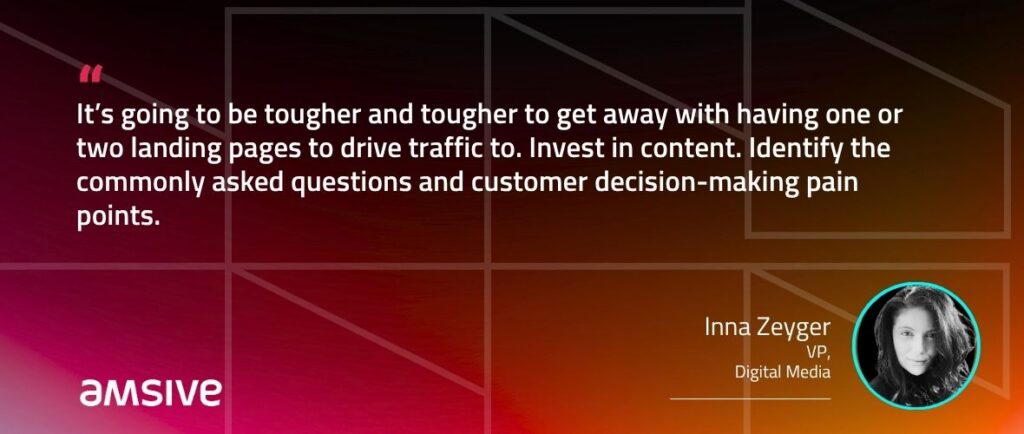
Traditional search is not disappearing overnight. AI Mode may not become the default Google Search experience immediately, which gives marketers some breathing room. But that should not be mistaken for stasis. Google is still reimagining search around AI-assisted queries, follow-up questions, multimodal inputs, and agentic discovery.
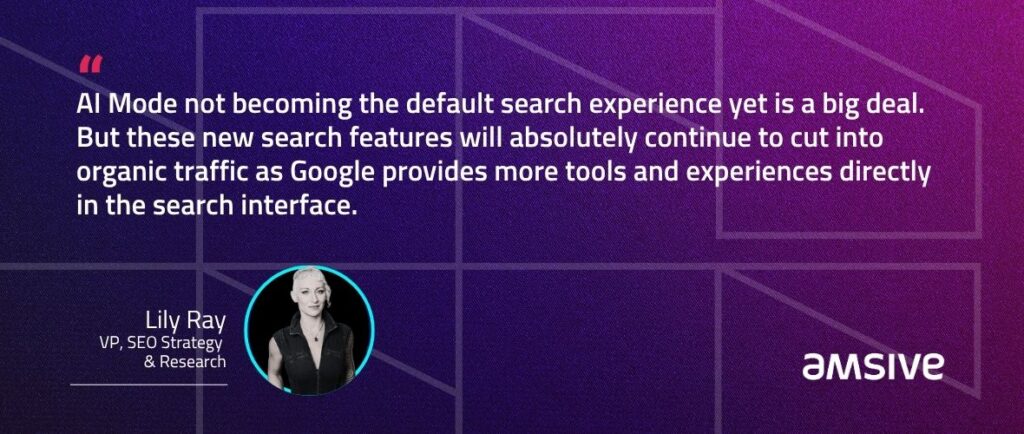
For some retailers, eCommerce brands, and local businesses, that may mean more personalized experiences and stronger conversion potential from the users who do click through. For high-consideration categories like healthcare, education, financial services, and insurance, the implication is broader: brands need to think beyond traffic alone and focus on how accurately, consistently, and persuasively they are represented in AI-driven discovery.
What to do now:
- Audit the questions your highest-value customers ask before, during, and after they enter the market.
- Expand thin landing pages into useful answer ecosystems, including FAQs, proof points, reviews, expert perspectives, images, and video.
- Make sure SEO/AEO and paid media teams are working from the same understanding of what your brand should be known for and when it deserves to be recommended.
Media & advertising: Automation raises the value of better signals
Most conversations about Google’s AI-powered media products focus on automation: AI Max, PMax, broad match, Demand Gen, automated creative, automated bidding, and Ask Advisor recommendations.
That attention makes sense. Google reported that AI Max campaigns drove 27% more conversions compared with manual campaigns, and that advertisers adopting AI Max or PMax saw 15% more conversions at similar ROAS. Marketers should test those claims against their own data, but the direction is clear: Google is making it easier for advertisers to expand reach and find demand with less manual campaign control.
That is useful. It is also where marketers need to be careful.
Reach is not the same as relevance. Automation is not the same as strategy. And platform-reported performance should not be treated as the full picture of business impact.
Many AI-powered products, including Google’s, are designed to expand delivery and find more conversion opportunities. That can create real growth, but it can also create broader matching, faster spend, and more expensive learning if the system is working from generic inputs. The less clearly a brand defines its audience, conversion quality, creative direction, exclusions, and business goals, the more room the platform has to explore on the brand’s budget.
So the answer is not to reject automation. It is to give automation better direction.
Across the GML announcements, Google made that point in several ways. AI Max needs strong audience and conversion signals. PMax needs accurate feeds and creative assets. Demand Gen needs useful audience and creator inputs. Business Agent for Leads needs strong website content to answer questions well. Measurement tools like Data Manager, Tag Gateway, and Meridian need clean, connected data to produce useful insights.
In other words, automation does not eliminate the need for media strategy. It changes what media strategy needs to organize.
That is why signal architecture becomes critical.
Signal architecture is the structure that turns audience data, creative assets, website content, CRM insights, conversion data, expert perspectives, reviews, and measurement signals into usable intelligence for AI systems. Every review, creator video, product feed, landing page, offline conversion, and customer interaction contributes to the larger system AI uses to understand, position, and optimize a brand.
The challenge is no longer simply producing more signals. It is making sure those signals are accurate, connected, and pointed toward the right business outcomes.
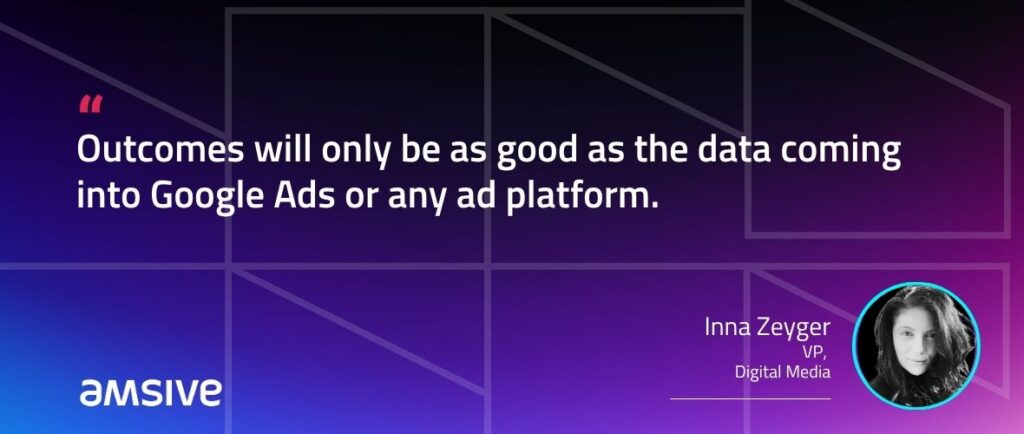
The AI systems themselves are not the advantage. The quality of the inputs is.
The shift toward automation does not remove the need for human judgment. It changes where that judgment matters most. Platforms still make decisions based on the data marketers feed them, which makes audience strategy, offline conversion integration, first-party data quality, exclusions, and clear business goals more important, not less.
Google may be giving marketers fewer manual levers to pull inside the platform. But that should free teams to spend more time defining what success actually means, which audiences are most valuable, what signals indicate quality, and where the brand should not spend.
Audience strategy creates coherence. Channel expertise creates effectiveness.
What to do now:
- Check whether Google’s AI is optimizing toward the outcomes that actually matter to your business, not just the easiest conversions to track (ex: offline conversions, lead quality, revenue, appointments, enrollments, policies, or lifetime value).
- Strengthen first-party audiences, offline conversion imports, exclusions, and negative signals before expanding aggressively into broader automation.
- Use AI Max and PMax to expand reach, but validate performance against business outcomes, not platform-reported efficiency alone.
YouTube and creators: Human trust becomes performance fuel
Google used GML 2026 to position YouTube and Demand Gen as more than awareness channels. The argument was clear: YouTube is becoming a stronger bridge between discovery, trust, search behavior, and conversion.
Google reported that adding creator assets to Demand Gen campaigns increases conversion lift by an average of 20%. It also said viewers are 13 times more likely to search and five times more likely to buy when a YouTube creator talks about a product.
Those are Google-reported figures and should be validated against each brand’s own performance. But the strategic implication is still important: creator content is becoming an essential performance input, not just a social tactic.
For marketers, that means creator strategy needs to be connected to more than brand awareness or social engagement. Creator content should support full-funnel paid media performance, organic AI visibility, search behavior, and audience trust.
This matters because AI systems increasingly learn about brands the same way people do: through accumulated layers of expertise, experience, and trust. Reviews, creator partnerships, expert commentary, educational content, customer stories, and first-hand perspectives all help teach platforms what a brand stands for, who trusts it, and when it deserves to be recommended.
That makes human expertise an essential structured input for AI systems.
This is true far beyond traditional influencer-heavy industries like beauty or fashion. Healthcare, insurance, financial services, education, and B2B brands all benefit from credible subject matter experts and creator ecosystems that develop helpful, personalized, situation-specific educational content.
In these high-consideration categories, people are not just choosing a product. They are choosing who to trust with their health, education, finances, coverage, or future plans. Human voices, expert perspectives, and real-world proof help create the specificity and credibility AI systems need to understand and represent a brand accurately.
Generic content gives AI little reason to distinguish one brand from another. Expertise, experience, and real human perspective give AI systems something more meaningful to understand and recommend.
What to do now:
- Treat creator content as an essential element in paid media, organic AI visibility, and brand trust – not just a social deliverable.
- Identify which experts, creators, customers, or internal voices can credibly explain your brand in ways generic content cannot.
- Evaluate whether YouTube creator content belongs in your Demand Gen strategy, especially if YouTube is already influencing search and consideration.
Creative: The campaign mindset is too static for AI
Google shared that creative drives nearly 50% of incremental ad sales.
That matters. It also tracks with where many platforms are pushing brands to invest. Meta, for example, has increasingly framed creative as a major performance lever.
But marketers should resist oversimplifying this into “creative is everything.”
The better takeaway is that creative becomes more powerful when it is connected to audience insight, first-party data, measurement, media strategy, and platform-native behavior.
Creative can no longer operate separately from the systems that influence where, when, why, and to whom it appears. The strongest-performing creative systems are shaped by real audience behavior, measured against meaningful business outcomes, and continuously refined based on how people actually engage across platforms.
Google’s creative product announcements also pointed to a larger shift: in AI-driven ad environments, creative is no longer static.
With Asset Studio, AI Briefs, generative image and video tools, and one-click A/B testing moving deeper into Google Ads, brands can no longer think primarily in terms of fixed campaigns with fixed asset sets. AI-powered systems increasingly reward creative ecosystems that can be extended, personalized, dynamically assembled, continuously tested, and rapidly optimized across PMax, AI Max, Demand Gen, YouTube, and other Google surfaces.
The question is no longer simply, “Did we build a great campaign?”
It is: “Did we build a flexible, compelling creative system capable of evolving continuously?”
This changes how brands need to think about the entire creative operating model. Creative can no longer live as a static campaign deliverable handed off to media teams a few times a year. As Google’s creative and media tools become more connected, creative becomes a living system: continuously tested, adapted, personalized, and extended across platforms, formats, and audience moments.
That requires:
- stronger asset management
- clearer brand governance
- faster experimentation cycles
- tighter collaboration between media and creative teams
- better systems for capturing and sharing performance learnings
For regulated or highly scrutinized categories, this raises the stakes for governance. AI-assisted creative and answer generation need clear guardrails around claims, disclosures, eligibility, privacy, compliance, brand safety, consumer expectations, product relevance, and messaging before they scale through tools like Asset Studio, AI Briefs, or AI-powered ad formats.
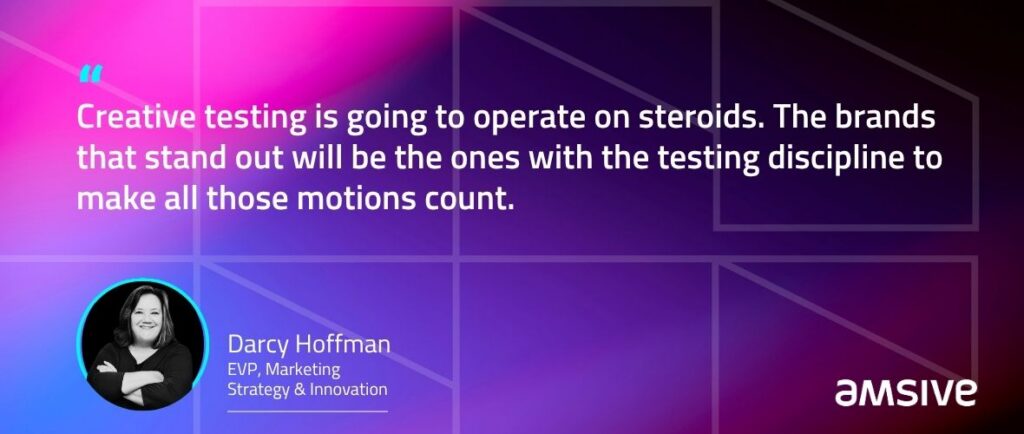
As Google accelerates creative production and optimization inside the ad platform itself, the advantage will not come from producing the most content. It will come from building a creative system with enough strategy, governance, audience insight, and testing discipline to make that content useful.
What to do now:
- Build modular creative systems that can be adapted across PMax, AI Max, Demand Gen, YouTube, and Asset Studio.
- Create clear AI creative guardrails around brand voice, claims, compliance, offers, and exclusions before scaling AI-assisted production.
- Tie creative testing to audience and measurement strategy, so you’re learning which messages, formats, proof points, offers, and creative treatments move specific audiences toward meaningful outcomes.
Commerce, local, and web: The basics are now AI inputs
One of the practical takeaways from GML 2026 is that the “basics” matter more, not less.
Google’s announcements around Universal Commerce Protocol, Universal Cart, Direct Offers, AI shopping ads, Business Agent for Leads, Merchant Center, and Google Business Profiles all point to a more AI-mediated environment where product, location, service, and business information must be structured, accurate, and useful.
For retail and eCommerce brands, that means product feeds, inventory, pricing, promotions, taxonomy, checkout integrations, and Merchant Center data become essential inputs into AI-powered discovery and transaction experiences.
For non-retail categories, the same principle applies differently. In education, program details, admissions requirements, campus information, costs, outcomes, and location data need to be clear and structured. In healthcare, provider profiles, services, locations, insurance acceptance, availability, and patient education need to be accurate and easy to understand. In financial services and insurance, plan information, eligibility details, disclosures, product comparisons, rates, and advisor or agent information need to be consistent and accessible.
This is where AI exposes operational fragmentation quickly.
If a brand’s website says one thing, its landing pages say another, its listings are incomplete, its content is thin, its CRM data is disconnected, and its local profiles are stale, AI systems will struggle to represent that brand accurately.
The basics are no longer just hygiene. They are AI inputs.
And as Google introduces more agentic ad experiences, including Business Agent for Leads, those inputs become even more important. If an ad can answer questions based on a brand’s website, then website quality, content depth, and information architecture directly affect the customer experience inside the ad itself.
That is a meaningful shift. The website is no longer just where ads send users. It is part of how AI systems understand and explain the brand.
What to do now:
- Audit the accuracy and consistency of the brand information Google can see: website content, feeds, Merchant Center, GBP, local listings, reviews, and landing pages.
- Identify which structured data matters most for your category, whether that is product inventory, provider availability, program details, eligibility criteria, locations, or service information.
- Treat the website as an AI search and advertising input layer, not just a post-click destination.
Measurement: AI can only optimize what it can see
Measurement may be one of the most important strategic shifts from Google Marketing Live.
Historically, measurement helped marketers understand what happened after campaigns ran. It showed up in reporting, dashboards, attribution reviews, incrementality tests, and media mix models.
That role is changing.
In AI-driven media systems, measurement does not just explain performance. It influences performance. AI systems learn from conversion quality, offline outcomes, and the causal signals that tell platforms what is actually working.
Bad measurement does not just create bad reporting. It can directly degrade performance.
That is why Google spent so much time on data and measurement at GML 2026. Data Manager, Tag Gateway, Meridian, and Google Analytics 360 all point toward a more connected measurement ecosystem. But the clearest signal may be the launch of two new metrics: Attributed Branded Searches (ABS) and Qualified Future Conversions (QFC).
Attributed Branded Searches are designed to show when advertising creates near-term branded search demand. Qualified Future Conversions are intended to connect earlier signals, like branded searches, video views, and site visits, to potential conversions up to six months later. Together, they reflect a broader shift away from measuring only immediate clicks and toward measuring how marketing creates demand over time.
Google said only 40% of Demand Gen conversions happen in the first 30 days. If your measurement system only rewards immediate clicks or short-window conversions, it may undervalue the channels and tactics creating future demand.
One caution: marketers should still understand the incentives of any platform-reported model. Google’s MMM and predictive tools may be useful, but sophisticated marketers should validate them against backend revenue, lead quality, incrementality testing, holdouts, and agnostic cross-channel models.
For brands operating primarily within Google’s ecosystem, tools like Data Manager may be a strong starting point. But for brands investing across broader media environments, the goal should be bigger than collecting Google data in one place. The real goal is to connect the data that explains audience value, business outcomes, and marketing contribution.
That is where broader customer intelligence matters. Unified systems can bring together Google data, household-level intelligence, offline signals, and broader intent ecosystems, giving both marketers and AI systems better signals to act on.
Ultimately, data strength is now foundational infrastructure for both AI performance and AI measurement.
What to do now:
- Connect the data that reflects real business value: offline conversions, lead quality, revenue, appointments, enrollments, policies, or lifetime value.
- Test Google’s new metrics, including Attributed Branded Searches and Qualified Future Conversions, but compare them with backend outcomes and incrementality evidence.
- Build a measurement view that connects data across channels so you can evaluate true performance and understand contribution across the full journey.
Ad-embedded AI will democratize marketing. Stronger brand systems will stand out.
One of Google Marketing Live’s clearest messages was that AI will make sophisticated marketing capabilities more accessible. Ask Advisor, AI Max, PMax, Asset Studio, AI Briefs, and automated creative testing all point toward a future where more teams can launch, optimize, measure, and iterate campaigns faster than they could before.
That is a meaningful shift, especially for SMBs and lean marketing teams that have historically lacked the resources, production capacity, or platform expertise to compete at scale.
The opportunity is real. But the brands that benefit most will be the ones that use Google’s AI tools with clear direction.
As more advertisers rely on the same platform-native agents, optimization models, generative creative tools, and AI-generated recommendations, differentiation will need to be more intentional. AI can help brands move faster, test more, and personalize at greater scale. But it needs strong inputs to produce work that feels specific, credible, and recognizably tied to the brand.
That matters because many of Google’s new ad experiences are designed to generate, assemble, and personalize brand messaging inside the platform itself. If the inputs are clear, distinctive, and well-structured, AI has more to work with. It can help scale what makes the brand valuable instead of simply producing more variations of familiar category language.
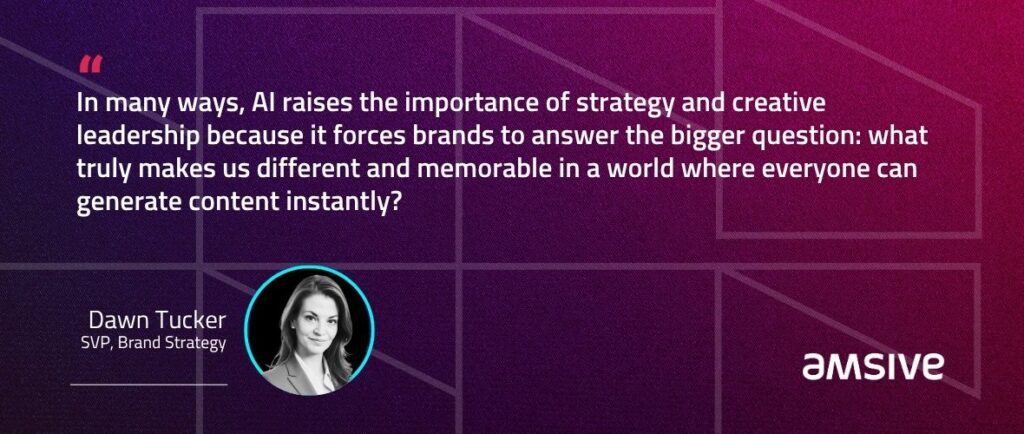
The brands that stand out will be the ones that make their difference easy for AI to understand: their expertise, customer insight, brand voice, creative point of view, and what they know that competitors do not. AI should help strong brands scale what already makes them distinct.
This is especially important in crowded categories, where many brands compete with similar promises. As Universal Cart, agentic commerce, AI-generated comparisons, and conversational shopping experiences make it easier for consumers to evaluate options, broad claims about quality, service, trust, or value will need more proof, specificity, and texture.
The winners in this next era will not be the brands using the most Google AI. They will be the brands giving Google’s AI systems something meaningful, useful, and distinct to understand, represent, and optimize.
What to ask your agency after Google Marketing Live
Google’s Ask Advisor and AI-assisted campaign workflows point to a future where more execution happens inside the platform itself. That should raise expectations for agencies, not lower them.
As AI makes execution faster and more accessible, marketers should expect agencies to bring more strategic value, stronger systems, and clearer accountability.
When evaluating agency partners, don’t just ask: “What’s your process?”
Ask: “How have you operationalized your expertise into systems AI can actually learn from and scale?”
Agencies should be able to show how audience insights are captured, how brand intelligence is documented, how creative learnings are shared across teams, how measurement signals inform optimization, and how institutional expertise becomes reusable operational knowledge.
That matters because AI does not automatically create better judgment. It accelerates whatever system it is plugged into. If an agency’s expertise lives only in scattered decks, individual team members’ heads, disconnected channel workflows, or one-off campaign recaps, AI will have limited ability to extend it.
As execution gets easier for everyone, the ability to turn expertise into repeatable systems becomes more valuable. The agencies that stand out will be the ones that can turn strategy, data, creative learning, and subject matter expertise into connected systems that help brands move faster without becoming more generic.
How marketers should respond to Google’s AI Roadmap
The practical takeaway is not to wait until every Google AI product is perfect, fully transparent, or universally adopted. The better move is to start strengthening the systems those tools will depend on.
Before going deeper into AI Max, PMax, Demand Gen, Asset Studio, Ask Advisor, or Google’s new AI Mode ad experiences, marketers should ask:
- Are we giving Google’s AI the right data to optimize against? Is our first-party data clean, usable, privacy-safe, and connected to the outcomes we actually care about, including offline conversions, lead quality, enrollments, appointments, policies, revenue, or lifetime value?
- Are our Google-visible brand inputs accurate and useful? Do our website, landing pages, product feeds, Merchant Center data, Google Business Profiles, reviews, local listings, images, videos, and structured content clearly and consistently represent our brand?
- Are we ready for ads to become answers? If AI Mode ads, Business Agent for Leads, AI-powered shopping ads, and Direct Offers pull from our assets, content, feeds, and site experience, are we giving them enough specificity to answer real customer questions well?
- Are our media, SEO/AEO, creative, analytics, CRM, and web teams aligned around the same audience strategy? Google’s AI systems will connect signals across surfaces whether the organization is aligned or not. The question is whether those signals reinforce each other or compete with each other.
- Are we building creative for Google’s AI-powered asset ecosystem? Do we have modular, brand-governed assets that can be adapted, personalized, tested, and scaled across YouTube, Demand Gen, PMax, AI Max, and Asset Studio?
- Can we validate Google’s performance recommendations independently? Do we have measurement infrastructure strong enough to compare platform-reported performance with backend revenue, lead quality, incrementality testing, MMM, or broader cross-channel models?
- Have we operationalized our expertise and differentiation in ways Google’s AI can understand? Are expert perspectives, creator content, reviews, FAQs, educational content, product details, and brand POVs structured enough to help AI systems accurately represent why customers should choose us?
AI embedded within Google’s platforms will keep making execution faster. But faster execution will not automatically create better performance. The brands that benefit most from Google’s growing AI ecosystem will be the ones that make their strategy, signals, expertise, creative, and measurement easier for AI to understand and act on.
Because ultimately, AI will not be the advantage.
Better marketing systems will be.
Discover how AI and predictive intent are redefining marketing, or let’s talk about achieving more for your marketing and your business.