

The latest Mailers’ Technical Advisory Committee (MTAC) quarterly session offered a clear view into where direct mail is heading next. MTAC is a USPS advisory group made up of industry experts and major mailers, including Amsive, who collaborate directly with USPS leadership on pricing, incentives, and operational changes that impact the entire mailing ecosystem. As a member, Amsive participates in these discussions firsthand, giving us a direct view into the decisions shaping the future of the channel.
Teams treating direct mail as a performance channel already have a head start on the shifts that MTAC discussed. What’s changing now is not the role of direct mail, but the level of precision required to make it efficient at scale. High-performing programs are increasingly defined by signal-based activation, propensity and lifetime value modeling, and tightly controlled timing tied to real consumer behavior.
Let’s explore the impact that these updates will have on direct mail strategy and activation.
Key takeaways:
- Direct mail performance depends on precision, with audience selection, timing, and signal-based activation driving efficiency at scale
- Signal-based orchestration is replacing static segmentation, allowing marketers to trigger mail based on real-time intent and consumer behavior
- AI is transforming direct mail into an adaptive system by continuously optimizing targeting, timing, and audience prioritization based on performance data
Jump To:
From volume to precision: how USPS’ changes are reshaping performance
USPS is adjusting pricing to reflect mail’s value, with an increase of 4.8% expected in July for Marketing Mail and First-Class Mail. This shift aims to clear out low-effort mailbox clutter. Broad targeting and fixed deployment schedules are giving way to precise, data-driven direct mail deployment. As the investment level rises, brands that prioritize quality over quantity capture more attention and drive higher response rates.
Audience selection carries the most weight, followed by timing and how well direct mail works alongside digital channels. Programs grounded in active decisioning are the ones that outperform their competitors.
A major theme from the MTAC discussions was the continued shift toward signal-based orchestration as a core driver of performance. Rather than relying on static segmentation, leading programs are triggering mail based on real-time or near-real-time signs such as digital engagement, lifecycle events, and predictive indicators of readiness. This allows marketers to align delivery with intent, not just audience definition.
Start by taking inventory of the signals that you already have. Most organizations have access to meaningful data across hand raisers, behavioral patterns, and predictive indicators—but performance depends on identifying which signals can accurately be acted on.
As signal complexity increases, AI is also becoming critical in decisioning. Machine learning models can prioritize audiences based on likelihood to respond, optimize timing windows, and continuously refine targeting based on performance feedback. This turns direct mail into an adaptive system rather than a fixed campaign channel.
Structural changes could impact efficiency
USPS is streamlining pricing structures and standardizing terminology. The move toward 3-digit presort levels over Area Distribution Center (ADC/AADC) entry discounts clarifies forecasting. It also removes a layer of operational optimization that mailers previously used to manage spend.
Program design is set to become a primary driver of efficiency. Marketers need to optimize around the triggering event, frequency, and signal connection that leads to someone receiving a piece of mail. Investment and budget control should be pieces of strategy, not operational mechanics. For some organizations, the challenge isn’t lack of data, but overall data fragmentation. Web behavior, CRM data, and transactional data often exist across separate platforms, making it difficult to see signals clearly and act on them while consumer intent is still high.
From a technical standpoint, MTAC discussions reinforced that efficiency will now come from how programs are designed, not just how mail is entered. That said, leading organizations are still pairing strong postal design with disciplined postal strategy, including optimizing sort methodology, refining in-home delivery timing, and leveraging commingling specifications to control costs.
Promotions map USPS growth goals
USPS incentives show where the channel is heading. The 2027 Marketing Mail Promotions introduce two new programs: Impact Messaging, which offers a discount for campaigns that promote the Postal Service and mail, and Direct Mail Discovery, which supports new direct mail users with a discount on their first 5,000 pieces, as well as a credit to an eDoc submitter.
Tactile, Sensory, and Interactive remains a priority, now with two discount tiers designed to drive stronger engagement and behavior. At the same time, USPS is phasing out Continuous Contact and Catalog Insights, signaling a shift away from legacy programs toward formats and strategies that encourage testing, participation, and more intentional use of the channel.
This phaseout is one of the clearest indicators from MTAC is that USPS is actively encouraging experimentation. These promotions can be viewed as mechanisms to allow brands and marketers to fund testing. Exploring new formats or expanding into fresh segments becomes highly cost-effective under these incentives. Smart brands leverage these discounts to maximize their investment while improving campaign performance.
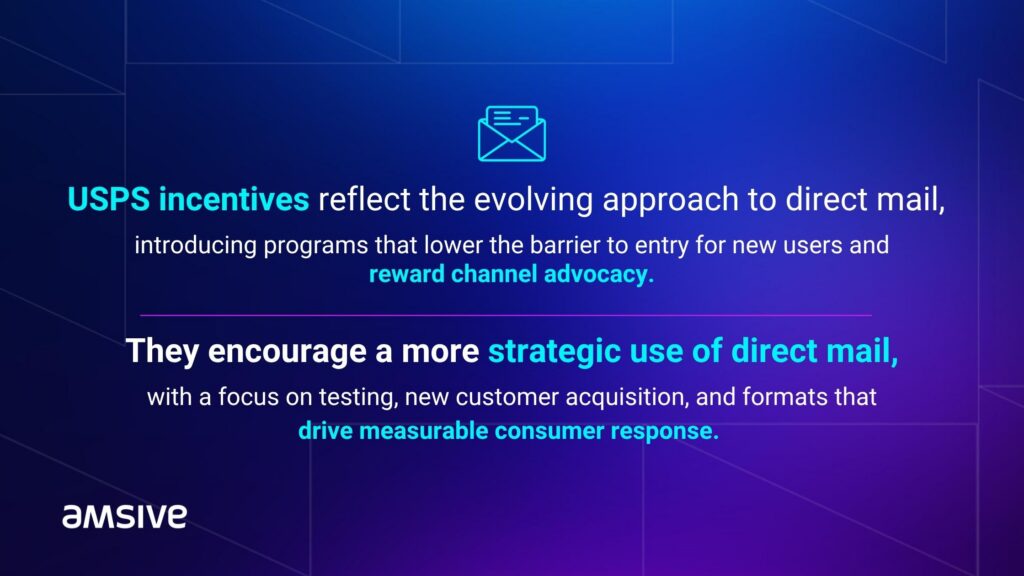
In practice, this means using incentives to offset the cost of trying new formats, testing new audiences, or piloting more advanced signal-based programs. As these programs evolve, integrated technology is playing a larger role. AI-assisted creative can dynamically adjust messaging based on audience signals, while emerging capabilities like voice-enabled direct mail experiences create new ways to engage and qualify recipients.
At a foundational level, this experimentation is only as effective as the system behind it. Establishing rapid, consistent data feeds into marketing workflows allows teams to act on signals as they happen, while more advanced approaches like continuous monitoring through a CDP can support real-time visibility into consumer behavior.
Applying digital measurement to physical mail
Tracking and visibility were also popular topics in the recent “Reimagining Mail” initiative discussions. Better reporting has led to direct mail being compared more rigorously to digital channels, proving its contribution to the bottom line.
Marketers have to demonstrate how mail drives outcomes across the entire customer journey. Timing, sequencing, and cross-channel interaction determine how teams interpret performance. Direct mail requires the same measurement frameworks as digital media, with tools like Multiltrac giving marketers clearer visibility into response, timing, and impact.
Closed-loop measurement is what takes direct mail from a tactic to a system. Connecting signals, activation, and outcomes allows marketers to understand what’s working, where response is being driven, and how to continuously optimize performance.
MTAC conversations also reinforced the importance of validating performance beyond attribution. Leading organizations are pairing closed-loop measurement with incrementality testing to understand true business impact. By comparing exposed and unexposed audiences, teams can isolate the actual lift driven by direct mail and make more confident investment decisions.
Data quality as a frontline financial defense
USPS is rolling out stricter compliance rules. Barcode errors and duplicates will trigger direct fees. Bad data wastes print and postage, muddying campaign results. Clean data can lead to better targeting, cuts wasted investment, and drives campaign efficiency. Validation, deduplication, and system integration are now frontline financial defenses.
Accurate data protects investment and maximizes ROI, making advanced data services and AI-supported data cleaning essential to maintain list quality and avoid penalties.


Integrating mail into the multichannel ecosystem
Together, these evolutions underline that actively strengthening mail’s value within the broader multichannel ecosystem. Direct mail holds attention, stays visible longer, and cuts through digital fatigue. When timed correctly, it amplifies intent forming in other channels. It performs best as part of a signal-driven direct mail framework, integrated with digital, paid media, and lifecycle programs.
When direct mail is properly integrated in this strategy, its role is tightly timed to customer intent, supporting specific decisions and driving clear, defined actions.
In many high-performing programs, this shows up as mail being triggered after meaningful digital engagement but before conversion, reinforcing brand trust and accelerating decision-making at a critical moment.
FAQs
How do these USPS changes impact direct mail marketing?
USPS pricing updates and structural changes are increasing the cost of low-effort mail, pushing marketers toward more precise targeting, better timing, and data-driven program design to improve and maintain efficiency.
Why is there an increased focus on data quality for direct mail?
USPS is rolling out stricter compliance rules, meaning barcode errors or duplicates will trigger added fees. Clean data protects your budget, eliminates waste, and guarantees better campaign performance.
Why is signal-based direct mail important for performance?
Signal-based direct mail allows marketers to trigger campaigns based on real-time consumer behavior and intent, making outreach more relevant and significantly improving response rates.
What do the structural pricing changes actually mean for my campaigns?
USPS is standardizing terminology and moving volume to 3-digit presort levels, which limits some of the old operational workarounds. Going forward, you’ll secure campaign efficiency through smarter program design rather than backend logistics.
What role does AI play in direct mail marketing?
AI improves direct mail by analyzing consumer signals, predicting response likelihood, optimizing send timing, and continuously refining audience targeting to increase performance and reduce waste.
Take the next step
The organizations that respond early to these shifts put themselves in a stronger position to control costs, capture incentives, and improve performance. Those that hesitate will face higher costs, reduced flexibility, and a harder path to efficiency.
To stay ahead, take these steps right now:
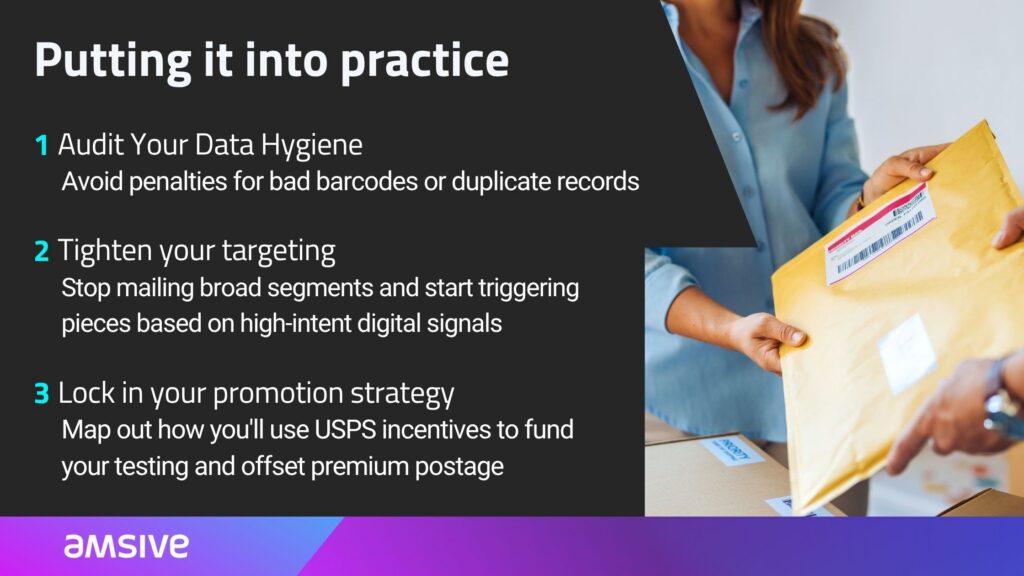
Direct mail advantages now come from combining signal-driven orchestration, AI-powered decisioning, and disciplined operational execution, informed by the same technical shifts being discussed directly with USPS. Marketers who continue to treat mail like a premium, measurable investment will protect their budgets and drive sustainable growth.
Looking for more direct mail insights? Watch our recent webinar to learn how high-performing brands are utilizing direct mail, or let’s talk about how Amsive can help you future-proof your marketing strategy.