Marketing gets easier when it centers on your best audience.
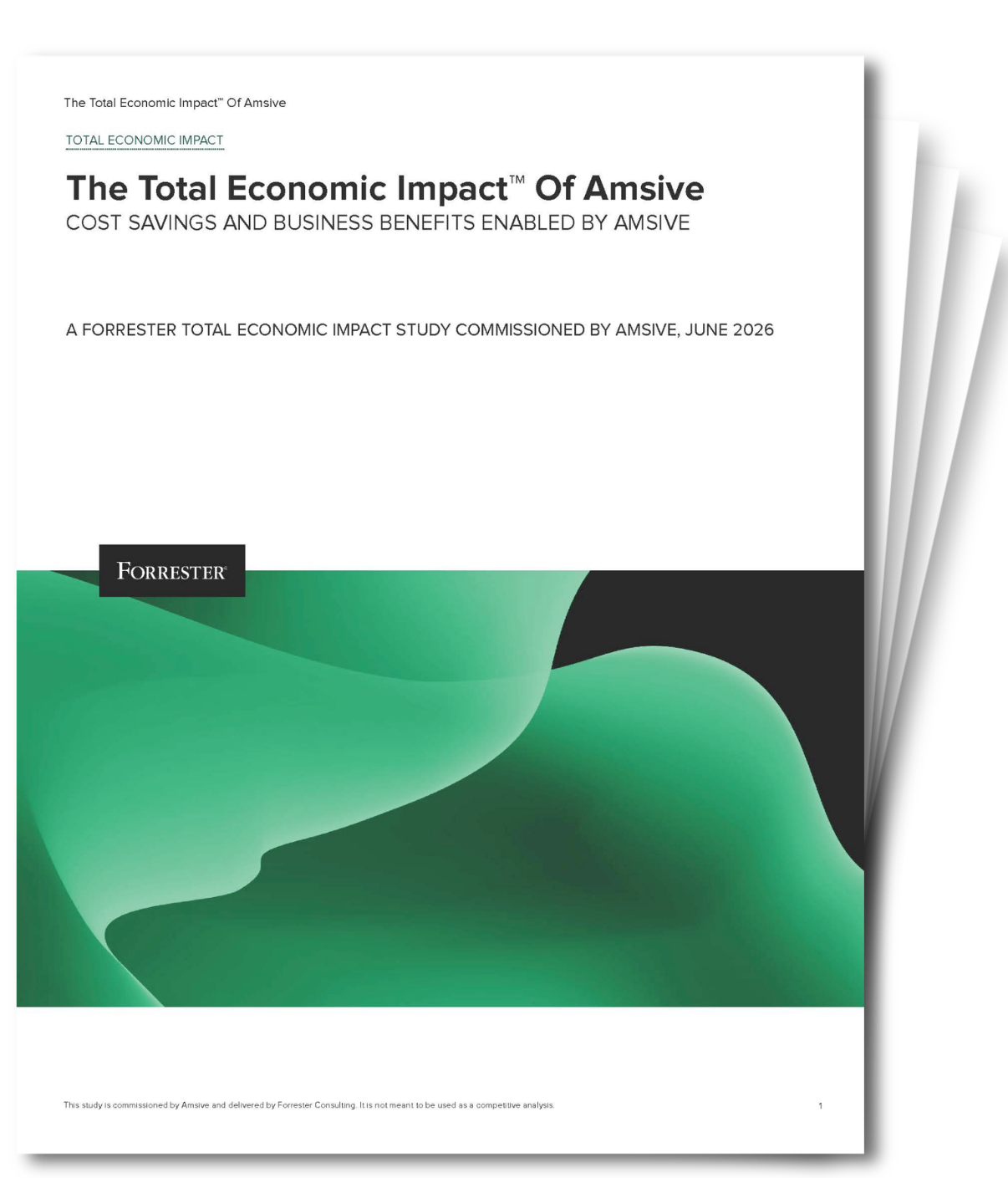
The Total Economic Impact™ Of Amsive, a commissioned study conducted by Forrester Consulting, found that a composite organization representative of interviewed customers with experience using Amsive saw a 40% increase in annual customer growth. The gain came from concentrating on the prospects most likely to convert, then coordinating every channel against that audience.
Fragmentation works against that. Each specialist plans in isolation, budget can’t follow what’s working, and growth stalls while teams reconcile reports instead of acquiring customers. The brands that pull ahead aren’t running the most channels. They’re running them as one growth engine.
What the Forrester Total Economic ImpactTM study found:
Audience-led targeting accelerates growth. A 40% increase in annual customer growth, driven by focusing spend on the prospects most likely to convert and lowering cost per acquisition.
Consolidation compounds. 134% ROI over three years, payback in under six months, and $4.8 million in net present value.
One roster outperforms many. Retiring redundant retainers and overlapping services cut $3.6 million in legacy agency costs.
Coordination is capacity. Shifting vendor management to a single partner freed a 20% productivity lift for marketing teams.
See the full model, the assumptions behind it, and where the growth comes from.
What challenges does the current marketing approach create?
Fragmented, multiagency marketing leads to inefficiencies, inconsistent execution, and limited performance visibility. Interviewees for this TEI reported redundant costs, siloed campaigns, and difficulty tracking metrics, such as cost per acquisition (CPA), across channels. Before Amsive, internal teams spent significant time coordinating vendors instead of focusing on strategy. This resulted in missed opportunities to optimize spend and customer engagement.
Why should organizations consider changing to an integrated approach?
Interviewees reported stronger targeting, coordinated campaigns, and improved efficiency from a single partner model. The composite organization experiences a 40% increase in annual customer growth and improved cost per acquisition. These benefits were modeled based on customer experiences.
What is required to begin working with Amsive?
Successful onboarding begins with aligning business goals, audiences, data, and campaign priorities. Interviewees’ organizations dedicated internal marketing and other business stakeholder resources during the transition, working with Amsive to integrate first-party data, establish measurement frameworks, and implement supporting capabilities such as Audience Science and Xact where appropriate. The study modeled a four-month onboarding and transition period involving marketing staff. Requirements vary depending on organizational size, complexity, and scope of engagement.
What trends and technologies are driving the adoption of this approach?
Adoption is driven by audience intelligence, predictive modeling, and AI-enabled marketing optimization. Organizations increasingly rely on data-driven targeting and value-based bidding to improve campaign performance. Interviewees also highlighted the growing importance of optimizing for AI-driven search and analytics capabilities. These technologies enable more precise targeting and better measurement.
What ROI did the composite organization achieve with this solution?
What ROI did the composite organization achieve with this solution? The study calculated $8.4 million in total benefits versus $3.6 million in costs, resulting in a $4.8 million net present value and an ROI of 134%. These outcomes were based on aggregated experiences of interviewees’ organizations and modeled financial analysis over three years. Results may vary by organization.