

With the vast amount of marketing data available today, marketers are facing two key questions:
1. How can we use the data we have to drive clarity in our decisions?
2. How are we going to use that data to measure successful business impact?
Between media data, platform reporting, internal and external dashboards, attribution models, conversion reporting, and more, teams can quickly become surrounded and overwhelmed by metrics without the guidance to better understand what’s driving business results.
On top of that, consumer journeys, whether they’re B2B, B2C, or DTC, continue to evolve, along with expectations, creating a more complex and fragmented ecosystem than ever before. Attribution alone is no longer enough to make smart investment decisions. Marketers are increasingly investing in more integrated incrementality-based measurement strategies, with 52% of brand and agency marketers using it to gain a better understanding of campaign effectiveness.
First-party data is becoming one of the most valuable assets in modern measurement. As signal loss increases and platform visibility decreases, organizations that can leverage their own data effectively are better positioned to understand true performance, test intelligently, and make confident investment decisions.
Key takeaways:
- Attribution alone can’t reveal true business impact, making it insufficient for strategic decision-making
- Incrementality measurement separates correlation from causation, showing which marketing tactics actually drive growth
- An integrated approach combining multi-touch attribution, incrementality testing, and media mix modeling is essential to guide both optimization and long-term investment decisions
Jump To:
How do you determine what’s driving incremental business impact?
Attribution models can help marketers understand which touchpoints appear in a customer’s journey. However, as consumer journeys evolve, privacy policies and regulations continue to change, and media ecosystems grow more fragmented, attribution alone does not provide a complete picture of what’s pushing people further down the funnel.
Additionally, attribution struggles to properly value a channel’s contribution to the business, with multiple platforms taking credit for the same success, ballooning the attributed value. As a result, organizations are complementing attribution with incrementality as an agnostic success measurement. Incrementality should be considered a framework for determining whether marketing activities actually drove business outcomes and contributed to revenue.
Why attribution alone isn’t enough
Marketers initially developed attribution models to improve on more simplistic measurement models (last click), which credited the final interaction before a conversion regardless of earlier marketing influence. This is where multi-touch attribution (MTA) or data-driven attribution enter the discussion by distributing credit across multiple touchpoints along the consumer journey (fractionalized attribution). MTAs provide valuable insights, particularly for optimizing campaigns within a specific platform; however, they are still limited by what they can observe and report.
These limitations are especially tricky as consumers interact with brands across search, social, streaming, retail media networks, email, and offline channels, as well as answer engines (LLMs, AI Overviews, GPTs, etc.), which impact an organization’s ability to track and report.
At the same time, layering in privacy changes and restrictions, platform data restrictions and walled gardens, and privacy-first browsers make it difficult to track those journeys consistently across environments. As a result, multiple platforms may claim credit for the same conversion while the organization lacks visibility into the full cross-channel journey.
These challenges don’t take away from the importance of attribution. Instead, it demonstrates that attribution models are better suited for tactical optimizations at a platform or publisher level, rather than cross-channel strategic decision-making.
This is where the distinction between optimization and decision-making becomes critical. Attribution models are highly effective for optimizing media within platforms, but they’re not designed to inform broader business decisions like budget allocation, channel expansion, or long-term investment strategy. That requires a more complete measurement approach.
What incrementality actually measures
Incrementality focuses on the idea of causation rather than correlation. Instead of assigning credit to touchpoints in an observed conversion path, incrementality measurement attempts to answer the questions: “What would have happened if this marketing activity hadn’t occurred?” and/or “What is likely to happen if this marketing activity does occur?”
This is accomplished by comparing outcomes between exposed and unexposed audiences. Incrementality testing estimates the lift generated directly by a campaign or channel, helping organizations distinguish between outcomes that were caused by marketing and those that might have occurred anyway.

For example, some customers may already be planning to purchase from a particular brand. If they search for the brand name and click on a paid search ad before converting, attribution models may credit that ad with the conversion, even if the purchase would have happened regardless. Incrementality testing helps reveal the difference between correlation (attribution/proximity) and business impact (contribution), giving marketers a clearer view of which activities are driving business success.
Performance marketing requires a dual focus: understanding short-term conversion impact through attribution and incrementality testing, while also measuring long-term revenue contribution across channels. Incrementality plays a key role in bridging that gap by validating whether observed performance is truly driving business outcomes.
Common methods for measuring incrementality
There are several approaches to measuring incremental impact. Each one brings something potentially unique to an organization’s measurement plan, and not all of them are right for every business.
Holdout or audience-based testing
Holdout testing is one of the most common approaches to incrementality testing. This is where a control group is created and is intentionally left unexposed to a specific marketing activity. An organization then compares the outcomes between the exposed group and the control group, to measure the lift generated by the campaign.
Geographic testing
In geo-based testing, marketers apply different media strategies in comparable geographic markets to understand the impact of the channels. Similar to holdout testing, a channel or a campaign may be added or withdrawn from a specified geography and then performance is measured to reveal the incremental impact of the activity against the groups.
Media mix modeling (MMM)
Media mix modeling is a broader approach than holdout and geo-based testing. MMMs analyze historical data to estimate how different marketing channels contribute to business outcomes over time. Modern MMM techniques use more advanced statistical modeling and often incorporate experimental results to improve accuracy.
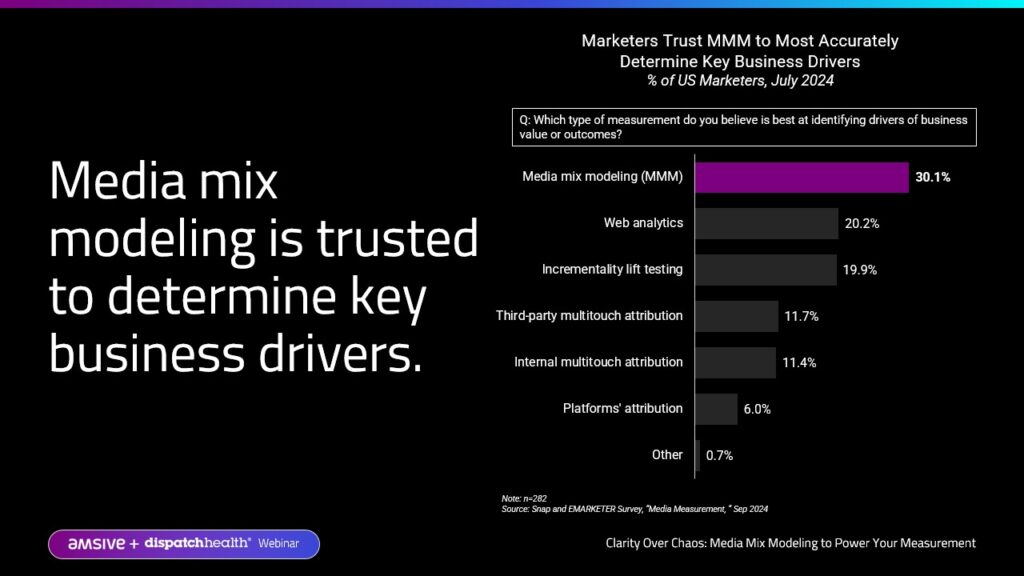
The use of historical data allows MMMs to see patterns in marketing impact on business success, and the advanced models allow for running thousands of simulations to test various outcomes. This makes them especially powerful for understanding the combined impact of both online and offline media. MMMs are typically used to support strategic planning and budget allocation across channels.
Modern media mixed modeling has evolved significantly from their traditional form. With more granular data inputs and advanced modeling techniques, they can be refreshed on a regular basis, such as monthly or quarterly, allowing organizations to move closer to live measurement. In some cases, models can be updated as frequently as new data becomes available, creating a more responsive and actionable view of performance across the full media ecosystem.
This evolution makes media mixed modeling a critical complement to attribution and incrementality testing. Performance marketing today requires understanding both short-term conversion impact through MTA and incrementality testing, and long-term revenue contribution through MMM, with both immediate performance and sustained growth being accurately measured simultaneously.
The goal: intentional measurement and more accurate reporting
As incrementality measurement gains attention, some organizations may think they need to abandon attribution. This isn’t the case. The most effective measurement strategies use multiple approaches together. It’s important to understand that each tool and method serves a specific purpose.
Attribution models are useful for day-to-day campaign optimizations by helping teams adjust tactics within a channel/platform: refining creative, audience targeting, and bidding strategies based on observed performance.
Incrementality testing helps organizations understand whether those activities are driving business outcomes in a more agnostic testing environment. While Holdout and Geography testing tend to be shorter-term tests, media mix modeling adds another layer by taking more of a long-term view to guide investment decisions across the entire media portfolio.
Together, these tools create a more complete measurement framework. The key isn’t choosing one method over another, instead using the method that fits the need right now.
At the center of this approach is a shift from reporting to decision-making. Measurement should actively inform how investment is allocated, how channels are prioritized, and how strategies evolve over time.
Best practices for building an incrementality-focused measurement strategy
For organizations beginning to explore incrementality measurement, or those that have been steeped in it for a while, here a few practical principles to help guide the process.
Start with a clear business question
Measurement should always begin with understanding the business question that needs to be answered and the decision you are trying to inform. For example:
- Should we expand our investment in a specific channel?
- Is our branded search strategy driving incremental value?
- Does this campaign generate demand or simply capture existing intent?
Framing the business question clearly will help determine the most appropriate testing method.
Set up manageable experiments
Incrementality testing does not need to be overly complex or expensive. It is common to start with simple holdout tests or geographic experiments to measure lift in specific campaigns, and measure signals early and often. Again, knowing what information is needed before the test will determine what those signals are and how much meaning they have.
Adopting a test-and-learn mindset as an always-on organizational strategy ensures that measurement evolves alongside changing consumer behavior, media environments, and business goals. Continuous experimentation enables teams to build institutional knowledge and improve decision-making over time.
Give tests adequate time and scale
One common pitfall is ending tests too early or running experiments that are too small to generate statistically meaningful insights. Properly designed tests require sufficient duration and sample size.
Invest in quality data
Reliable measurement depends on reliable data. Strong first-party data, consistent conversion definitions, and accurate exposure tracking are essential for meaningful results.
As third-party signals continue to decline, first-party data becomes even more critical. Organizations that invest in collecting, organizing, and activating their own data will have a significant advantage in both measurement accuracy and media performance.
Treat measurement as an ongoing learning process
Incrementality should not be viewed as a one-time study. The most effective organizations build a continuous testing roadmap, using insights from each experiment to inform future media investments. Similar to a good business plan, a good measurement plan starts with a goal but evolves with new information.
FAQs
What’s the difference between attribution and incrementality?
Attribution shows which touchpoints are associated with a conversion, while incrementality measures whether marketing actually caused that conversion. Attribution focuses on correlation. Incrementality focuses on causation and true business impact.
Why isn’t attribution alone enough anymore?
Attribution is limited by fragmented consumer journeys, privacy restrictions, and walled gardens. It can’t fully capture cross-channel influence and often over credits performance. It’s most effective for platform-level optimization, not strategic decision-making.
When should marketers use incrementality testing?
Incrementality testing provides the most value when evaluating whether a campaign, channel, or tactic is driving net-new impact. It’s especially useful for budget allocation decisions, validating performance, and understanding if marketing is creating demand or capturing existing intent.
How does media mix modeling fit into a measurement strategy?
Media mix modeling provides a long-term, holistic view of how all marketing efforts contribute to business outcomes. It complements attribution and incrementality by helping marketers understand broader trends and optimize investment across the full media ecosystem.
What role does first-party data play in modern measurement?
First-party data is foundational for accurate measurement. As third-party signals decline, organizations that effectively collect and activate their own data can improve targeting, strengthen testing accuracy, and gain a clearer view of true performance.

Move toward smarter marketing measurement
As marketing environments grow more complex, relying on a single measurement framework is no longer enough. Attribution models continue to provide useful signals for campaign and platform optimization, but they offer only a partial view of marketing effectiveness. By incorporating incrementality testing and broader measurement approaches like media mix modeling, marketers can move beyond reported conversions and toward a clearer understanding of true business impact.
The goal of a measurement plan isn’t just better reporting; it’s better decision-making. Organizations that embrace an integrated measurement strategy will be better equipped to strategically impact decisions around budget allocation, confidently identify the channels that truly drive growth, and ensure that marketing investments are delivering real value.
Looking for a deeper dive into media mix modeling? Watch our webinar and learn how to to power your measurement, or let’s talk about how to achieve more for your marketing—and your business.