
ChatGPT Ads create a new opportunity to reach people as they define problems, compare options, and work through decisions. Here’s how marketers should think about the channel, where it may fit by vertical, and how to prove whether it adds incremental value.
As marketers, we’ve spent decades building media strategies around audiences, keywords, placements, and channels. ChatGPT introduces a fundamentally different environment. Users are moving away from scrolling through a feed or reducing what they need to a few words in a search box, and are instead having conversations.
That changes more than the ad format. It changes how marketers should think about intent, audience development, campaign structure, and where ChatGPT fits alongside the channels already doing a job in the consumer journey.
The platform is also evolving quickly. ChatGPT Ads now supports campaign objectives focused on views, clicks and conversions, along with context hints, conversion measurement, and more developed campaign-management capabilities. Recent OpenAI updates also point toward a broader AI-native advertising ecosystem, including Sponsored Agents, AI-assisted campaign creation through ChatGPT Work, creative assistance, HubSpot and Shopify integrations, product feeds and measurement-partner connections.
The mechanics are becoming more familiar to digital marketers. Consumer behavior isn’t. That’s where the opportunity gets interesting.
Key takeaways
- ChatGPT Ads are best understood as a new decision-stage media environment, not simply paid search inside an AI interface.
- The opportunity is strongest when brands understand who they are trying to reach, what those people are trying to figure out, and where a relevant ad can help move the decision forward.
- Recent OpenAI updates, including Sponsored Agents, HubSpot and Shopify integrations, product feeds, and expanded measurement capabilities, are making ChatGPT Ads more connected to the broader marketing ecosystem.
- Evaluate performance against the role ChatGPT is meant to play in the journey, considering incrementality, assisted behavior, and downstream business outcomes alongside clicks and direct conversions.
Jump To:
ChatGPT is a decision environment, not another search engine
ChatGPT doesn’t replace paid search, social, display, video, or programmatic media. Its role in the consumer journey is different.
Search is exceptionally good at capturing expressed demand. Someone identifies a need, types a query, and essentially raises their hand. Social can help a consumer name a problem, idea, or product before someone is actively looking for it. Programmatic and video can create familiarity and reinforce a brand across environments.
ChatGPT becomes particularly interesting when someone is working through a decision. A user may recognize a problem without knowing the solution. They may understand the category but still need to evaluate options. Or they may already have a shortlist and want help comparing cost, features, outcomes, or tradeoffs.
For marketers, the opportunity is in participating while a consumer is forming the criteria they will use to make a decision.
Consider a prospective graduate student. A single conversation might evolve from:
“Is getting an MBA worth it if I’m already working full time?”
“Would an online MBA make more sense for me?”
“What should I look for when comparing online MBA programs?”
“Which online MBA programs offer flexible schedules, strong career outcomes and tuition under $50,000?”
In traditional search, those questions might occur across multiple queries, websites and sessions. In ChatGPT, much of that journey can happen inside one conversation.
Recent updates are making the experience more actionable
OpenAI’s recent product announcements suggest ChatGPT Ads are moving beyond a static sponsored placement at the bottom of an answer.
Sponsored Agents are one example. OpenAI is testing an experience where someone who engages with an eligible ad can begin a clearly labeled conversation with an AI representative of that business. Instead of immediately sending someone to a website, the experience could allow them to ask practical follow-up questions before deciding whether to take the next step.
OpenAI has also introduced integrations that connect ChatGPT Ads more directly to the broader marketing stack. HubSpot can support campaign creation, lead capture into CRM workflows and paid-media reporting. Shopify can connect product catalogs and commerce events to ChatGPT Ads, while product-feed and measurement-partner support can bring more commerce and performance signals into the ecosystem.
These capabilities are still evolving, but the direction matters: ChatGPT Ads are becoming less of an isolated experimental placement and more connected to the broader advertising and marketing technology ecosystem.
AI changes the form of intent, not the rest of the journey
Conversational AI doesn’t eliminate the broader consumer journey. Someone may begin with ChatGPT and then:
- Search the brands or products it surfaced
- Visit Reddit or another community for opinions
- Read reviews or independent publisher coverage
- Visit several brand websites
- Watch video or creator content
- Return to ChatGPT with additional questions
That means ChatGPT Ads, like any other channel, shouldn’t be planned in isolation. They need to be considered alongside paid and organic search, social, creator content, programmatic media, reviews and the third-party sources people use to validate what they are hearing. That multichannel thinking will help marketers understand where conversational discovery belongs within the broader marketing ecosystem.
Think beyond keywords: start with people and decisions
One of the easiest mistakes to make with ChatGPT Ads is treating context hints as the next version of keywords. They aren’t.
Context hints give OpenAI additional information about a product, service, consumer need or situation that may help determine when an ad is relevant. OpenAI’s current guidance encourages advertisers to think about what the product provides, who it’s useful for, and when that offering becomes relevant.
The important part is that those ideas should be expressed naturally.
Instead of: online MBA, business degree, graduate program, working professionals, flexible MBA
Think closer to: Flexible online MBA programs for working professionals who want to advance their careers without leaving the workforce.
The second version tells the platform more about the consumer and the decision. That distinction matters because conversational advertising creates an opportunity to move beyond a simple category signal and understand why someone is researching in the first place.
The inputs already exist
Marketers don’t need to guess what those conversations might look like. Many of the inputs already exist across the organization.
Understand who matters
- First-party and CRM data
- Existing converters and GA4 audience insights
- Consumer value or propensity analysis
- Audience intelligence platforms such as Resonate
- Persona and segmentation research
- Consumer interviews and sales data
When you’re considering all of these factors, look for commonalities between motivations, business pressures, life stages, barriers, and priorities that actually influence the decision.
Understand what they ask
- Paid search query reports
- Google Search Console and People Also Ask results
- Internal site search and FAQ data
- Sales, admissions or consumer-service conversations
- Reviews, Reddit and community discussions
- AI visibility and conversational-query research tools
Stop solely focusing on which keywords to target and instead ask what factors would make someone open ChatGPT and ask for help.
Think about the consumer’s decision, not just your product
The same product can be relevant across very different decision states. Someone may be trying to understand a problem, explore a solution, compare providers or determine whether the investment is worthwhile.
The product may not change. The information the person needs does.
Where ChatGPT fits will differ by vertical
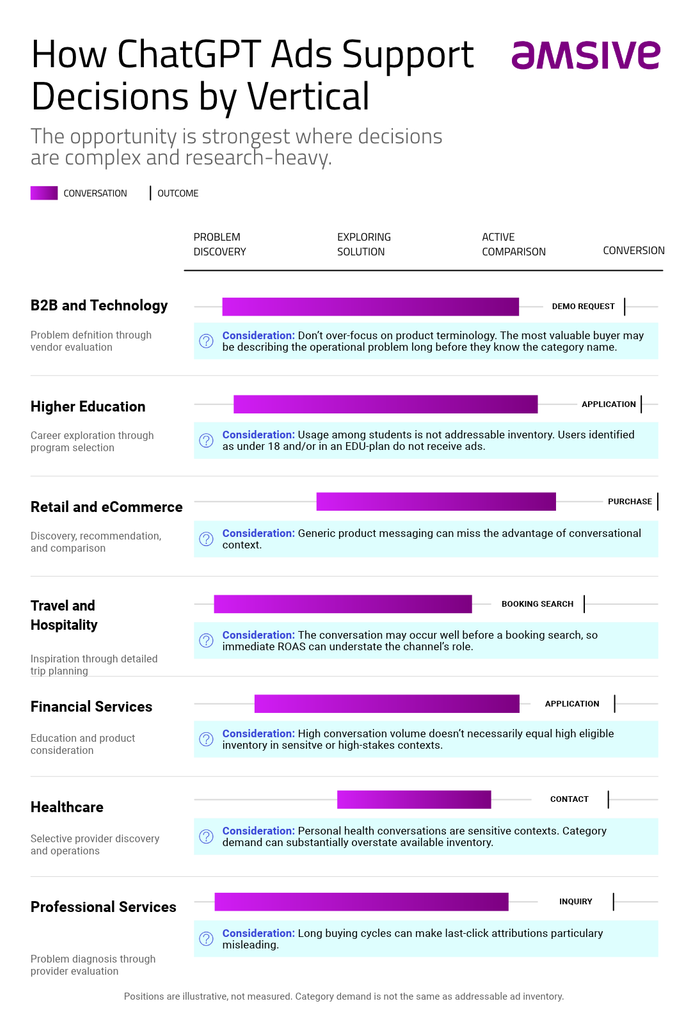
There is no universal ChatGPT Ads strategy because people use conversational AI differently depending on what they are trying to decide. The opportunity tends to be strongest where decisions are complex, research-heavy and difficult to reduce to a few keywords.
B2B and technology
In this vertical, ChatGPT Ads will work best for problem definition through active vendor evaluation. Buyers may use AI to understand business problems, solution categories, integrations, implementation, security, competitors, pricing, and ROI. The opportunity is often before the demo request, while the buyer is still forming the shortlist.
What to watch out for
Don’t over-focus on product terminology. The most valuable buyer may be describing the operational problem long before they know the category name.
Higher education
In this vertical, ChatGPT Ads will work best for career exploration through program selection. Graduate, online, adult, degree-completion, MBA, certificate and continuing-education programs are especially natural test cases because prospective students often balance career goals, flexibility, admissions requirements, cost and ROI.
What to watch out for
Total ChatGPT usage among students isn’t the same as addressable ad inventory. Users identified as under 18 and Edu-plan users don’t receive ads.
Retail and eCommerce
In this vertical, ChatGPT Ads will work best for product discovery, recommendation, and comparison. Conversational prompts can capture need state, price, use case, features, occasion and compatibility in the same interaction. Shopify and product-feed integrations make this category particularly worth watching.
What to watch out for
Generic product messaging can miss the advantage of conversational context.
Travel and hospitality
In this vertical, ChatGPT Ads will work best for inspiration through detailed trip planning. Users naturally combine destination, occasion, budget, traveler type, location preference, and activities in a single conversation.
What to watch out for
A travel-planning conversation may occur well before a booking search, so immediate ROAS can understate the channel’s role.
Financial services
In this vertical, ChatGPT Ads will work best for education and product consideration, with meaningful policy limitations. Eligible use cases may include general product comparisons, digital banking features, rewards, or business banking.
What to watch out for
High conversation volume doesn’t necessarily equal high eligible inventory in sensitive or high-stakes financial contexts.
Healthcare
In this vertical, ChatGPT Ads will work best for selective provider discovery, non-sensitive services, B2B healthcare technology and healthcare operations.
What to watch out for
Personal health conversations are sensitive contexts. Category demand can substantially overstate available advertising inventory.
Professional and business services
In this vertical, ChatGPT Ads will work best for problem diagnosis through provider evaluation. Buyers often start with a business challenge before they know which type of outside expertise they need.
What to watch out for
Long buying cycles can make last-click attribution particularly misleading.
Landing pages still matter
Conversational advertising doesn’t eliminate the need for a strong post-click experience. Advertisers select the destination URL, and OpenAI considers the landing page alongside other relevance signals.
The destination should continue the conversation. If someone is asking about MBA tuition, a generic university homepage may not be the best destination. If they are evaluating a specific software use case, the landing page should answer that use case. If they are comparing products, the destination should help them evaluate those products.
The principle remains familiar: reduce the distance between the user’s intent and the information needed to take the next step.
Measurement should match the role of the channel
Before launching ChatGPT Ads, advertisers need to solidify what job they’re asking this channel to do.
ChatGPT Ads can now be measured against familiar metrics including impressions, clicks, CPC, CPM, and conversions. Those are important, but they may not tell the whole story.
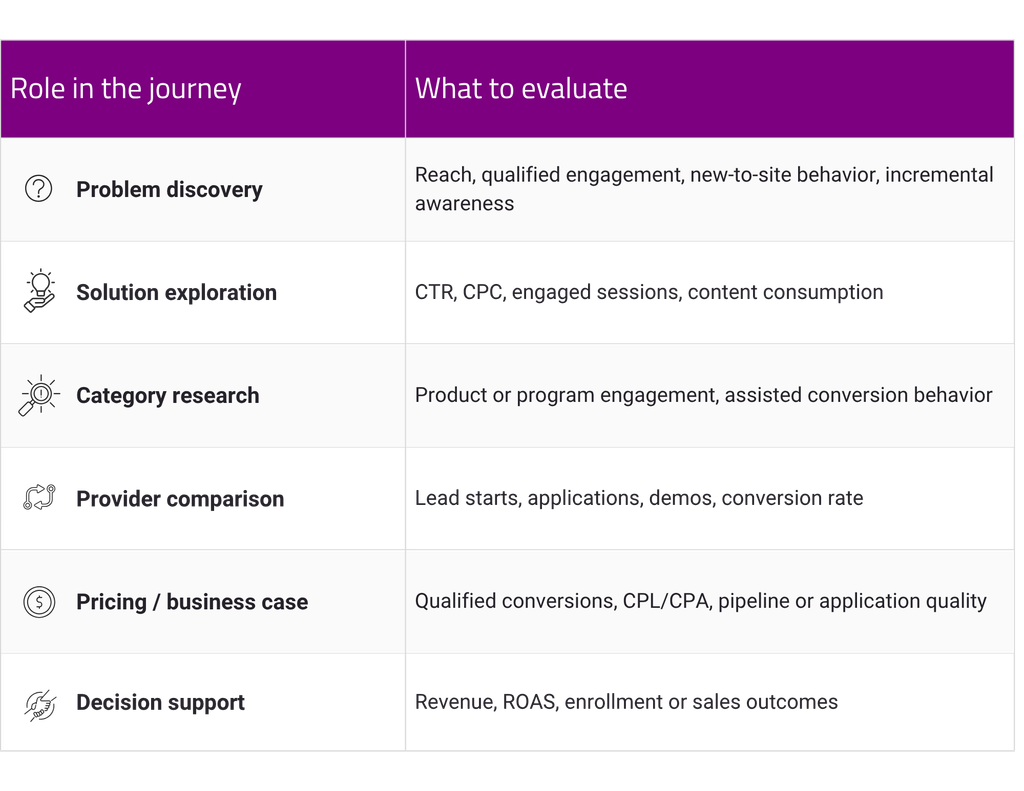
Consider someone who encounters a brand during a ChatGPT conversation, continues researching, leaves, later searches the brand on Google and converts. Last-click attribution may give search all of the credit. That doesn’t necessarily mean ChatGPT created no value.
Measure incrementality, not just attribution
Advertisers want to understand not only whether people clicked, but whether adding ChatGPT to the media ecosystem created behavior that wouldn’t otherwise have occurred.
Depending on the client, scale and category, that may include direct conversions, assisted conversion paths, branded-search changes, direct traffic, lead quality, revenue or pipeline contribution, and differences across exposed and unexposed populations.
Where appropriate, measurement approaches can include:
- Geo holdouts across comparable markets
- Exposed-versus-unexposed analysis where privacy-safe measurement allows it
- Branded-search lift and direct-traffic trends
- Conversion-path analysis across search, direct and other channels
- Structured on/off tests when stronger holdout designs aren’t feasible
The goal is ultimately to determine whether adding ChatGPT creates business activity that otherwise wouldn’t have occurred otherwise.
What do we know about performance benchmarks?
At this stage, we don’t have access to the performance benchmarks and data that marketers would like.
OpenAI doesn’t currently publish mature performance benchmarks by vertical or campaign type. Early third-party CPC and CTR data can provide useful directional context, but it shouldn’t be treated as an established standard.
OpenAI has recommended roughly a $3 to $5 maximum CPC starting range for CPC campaigns. Actual performance will vary based on vertical, intent, conversation type, creative, landing-page relevance, competition, campaign objective, contextual relevance and eligible inventory.
For a new channel like this, the first meaningful benchmark should be one that you set yourself. We recommend structured pilots designed to answer a business question rather than simply moving budget into ChatGPT and asking whether it produced clicks.


FAQs: ChatGPT Ads
Can advertisers see what competitors are doing?
OpenAI doesn’t currently offer a native public ad library comparable to Meta’s. Third-party intelligence tools are beginning to provide visibility into advertisers, creative, landing pages and conversational contexts, which can help identify competitive activity and white space.
Do ads appear across every version of ChatGPT?
No. Ads can currently appear to eligible users on Free and Go plans. Plus, Pro, Business, Enterprise and Edu plans remain ad-free, and accounts identified as belonging to users under 18 don’t receive ads.
Do ads influence ChatGPT’s answers?
No. Advertising is kept separate from ChatGPT’s organic answers and clearly labeled. Advertisers can’t pay to influence how the organic answer is generated.
How much control do advertisers have over matching?
Context hints provide relevance signals, not exact-match instructions. OpenAI evaluates multiple signals, including conversational context, the ad itself, the landing page and advertiser-provided hints. Testing and monitoring remain important.
What should advertisers know about brand safety?
OpenAI restricts ad placement around sensitive and brand-unsafe conversation categories, which provides a meaningful baseline safeguard. However, advertisers currently have less granular placement reporting and exclusion control than on many mature programmatic platforms. This deserves extra scrutiny in healthcare, financial services, legal and other sensitive categories.
What does a strong context hint look like in practice?
Don’t think of this as creating the longest possible prompt. The objective is to provide useful context about the consumer and the decision.
Consider an online MBA program. Traditional keyword thinking might start with “online MBA, MBA program, graduate degree, business school, online graduate program.” A conversational strategy starts further upstream.
Start with the audience
Audience research, CRM data and converter analysis might show that strong prospects tend to be working professionals who want to advance into leadership, cannot leave the workforce for school, and are evaluating whether the time and tuition required for a graduate degree will create enough career value.
Then identify the questions
- Is an MBA worth it if I already have several years of experience?
- Can I get an MBA while working full time?
- How long does an online MBA take?
- How much should I pay for an online MBA?
- Does an online MBA have the same value as an in-person MBA?
- What should I compare across MBA programs?
Turn those signals into a source sentence
Source sentence: Working professionals considering graduate business education often need to balance career advancement, scheduling flexibility, tuition and potential return on investment while comparing online MBA options.
Then build focused context hints
Career advancement
Flexible online MBA programs for working professionals who want to advance into leadership without leaving the workforce.
Cost and ROI
Online MBA options for professionals comparing tuition, program length, flexibility and potential career outcomes.
Admissions
Online MBA programs for experienced professionals researching application timelines, admissions requirements and programs that may not require standardized testing.
Program comparison
Online MBA programs for working professionals comparing schools based on flexibility, tuition, curriculum, reputation and career outcomes.
The difference is subtle but important. The first approach tells the platform which keywords are associated with the product. The second helps describe the person, the need and the decision.
Treat ChatGPT as an experiment worth proving, not simply another line item
ChatGPT Ads are still evolving rapidly. Sponsored Agents are in early testing. Integrations are expanding. Measurement capabilities are becoming more sophisticated. Product feeds and commerce connections are developing.
That makes now an interesting time to test, but it also makes disciplined testing more important.
At Amsive, our role isn’t simply to turn on another platform. It is to help brands determine where ChatGPT genuinely fits within the consumer journey, identify which audiences and conversational moments are worth reaching, connect the channel to existing search, social, programmatic and content strategies, and build measurement that can prove whether the investment is incremental.
Amsive can help brands:
- Assess where ChatGPT belongs within the existing media and consumer journey
- Develop audience and intent frameworks using first-party, search and audience intelligence
- Build and manage ChatGPT Ads campaigns and creative testing
- Align landing pages and measurement to the role of each conversational segment Design pilots that produce meaningful learning instead of vanity metrics
- Evaluate incremental traffic, demand and downstream business outcomes
- Determine where the channel deserves additional investment and where it doesn’t
Search taught marketers to understand what people type. Social taught us to understand what earns attention. ChatGPT is pushing marketers to understand what people are trying to figure out.
The opportunity is in understanding where your brand can genuinely help move the decision forward, and then prove that doing so creates incremental value.
Discovery now happens across a connected ecosystem. Check out our recent webinar to learn how to strengthen visibility and download your AI discovery readiness checklist, or let’s talk about how Amsive can help you supercharge your AI discoverability.