
The old healthcare marketing playbook isn’t holding up. Patients today have higher expectations, less patience, and decision paths that are anything but a straight line. They’re smarter and more selective, and they won’t hesitate to switch providers if they feel like their needs aren’t being met. They’re doing their homework: comparing doctors, reading reviews, and bouncing between social content and insurance portals before they even think about meeting with a provider.
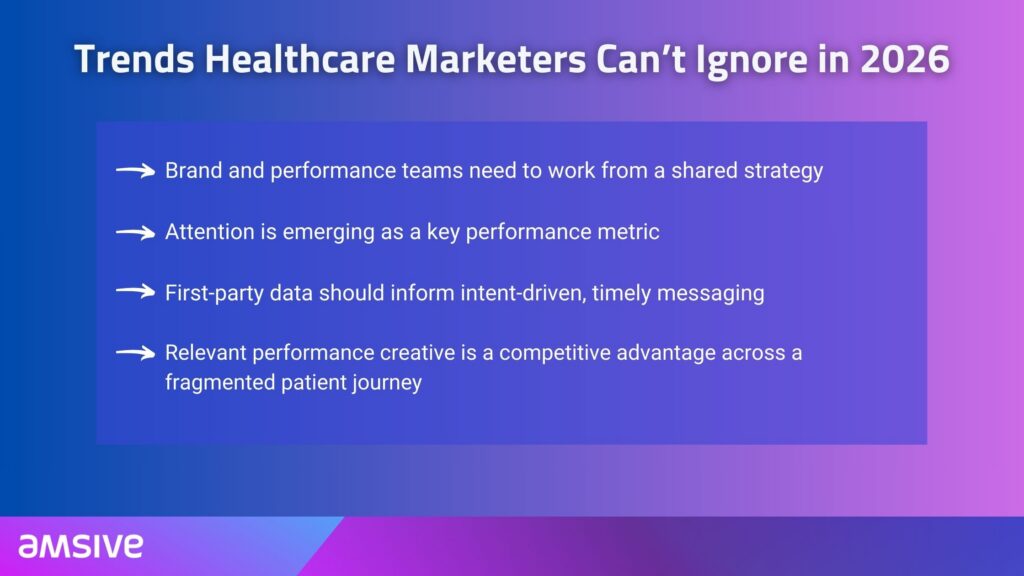
To connect with patients in 2026, marketers have to play by a new set of rules. These four shifts are impacting the new reality of healthcare marketing.
Key takeaways
- Keeping brand and performance teams separate leads to wasted investment and lower conversion rates
- With digital ad costs rising and patient focus fragmenting, meaningful interactions (like time spent with content) are a much better predictor of growth than vanity metrics like reach or impressions
- First-party data is the key to understanding a patient’s intent without overstepping into their private health information
Jump To:
Brand and performance have to work together
Healthcare teams have been siloed for a long time. Brand teams were tasked with building awareness and reputation, while performance teams optimized for leads, appointments, and overall efficiency. That split might have worked ten years ago, but in 2026, it can have a negative impact on your growth.
Patients don’t experience your brand in a vacuum. Their journey can move between search, social, provider websites, reviews, referrals, and insurance portals. If your social media says one thing, but your paid ads feel like they’re from a different institution, it can damage patient trust and redirect their focus to a competitor’s content.
In 2026, brand and performance need to work from one foundational strategy to reach a shared outcome. The messaging needs to feel the same from the first brand encounter to an appointment confirmation. When your creative works in harmony across every channel, you’re building brand recall that lasts.
The way we measure success is changing, too. High-performing teams are looking at what actually moves the needle, like whether a patient’s engagement actually led to enrollment, booking an appointment, or a return visit.
Once brand and performance are aligned, the next challenge becomes earning and holding attention across a fragmented set of touchpoints.
Attention is a key emerging metric
Measuring impressions and reach aren’t enough anymore. Attention is the new marketing currency.
Patients are constantly overwhelmed with messaging. They’re shown provider ads, insurance messaging, influencer wellness content, and pharmaceutical campaigns every day. Anything that feels irrelevant, repetitive, or confusing is guaranteed to be tuned out.
Healthcare marketers need to redefine their success metrics. Time spent with your content is becoming more important. It’s not about how many times you showed up in a feed. It’s about whether the patient actually remembered who you are.
It requires empathy and a deep respect for the headspace of someone making a big health decision. In healthcare, providing relevant and helpful content beats your ads being overly-personalized. If you over-target, you could come off as creepy. If you provide context, you come off as a partner.
That said, attention alone isn’t enough if teams can’t respond quickly to changing behaviors and high-intent moments as they appear.
Data should create relevance, not just personalization
Basic personalization doesn’t win trust the way it used to. 75% of respondents to a survey done by the HIPAA Journal have concerns about protecting their health data. With conversations around data privacy growing more prevalent, patients don’t want an ad that feels like you’ve been reading their medical charts. They want a partner that understands their situation.
The organizations staying ahead are using data to understand context. They look at search intent, timing, and can pinpoint patterns in first-party data to understand where someone is in their decision process—without relying on sensitive information.

This data can also turn understanding into meaningful action. Healthcare decisions can be impacted by stress or urgency. Your messaging should acknowledge that reality with a human touch. Use compliant, first-party data to get the timing right, then let your creative team communicate your empathy.
Performance creative is a competitive advantage
Creative is an underrated performance lever, and in 2026, it’s the connective tissue that helps a patient make sense of an often confusing and evolving healthcare system.
As patient journeys are increasingly fragmented, creative does the work of linking channels, shaping understanding, and guiding patients through complex decisions. Creative performs best when it’s tested, refined, and improved over time rather than treated as a one-and-done asset.
In 2026, healthcare organizations should invest more heavily in journey-aware messaging, emotionally intelligent storytelling, and channel-native execution. Just as importantly, they should test and iterate quickly, letting performance data shape creative decisions.
When strategy, analytics, and creative work together, performance improves without sacrificing patient trust.

FAQS: Healthcare Marketing Trends for 2026
Why is connecting brand and performance such a priority in healthcare marketing now?
Because patients don’t experience marketing in silos. They move between awareness, research, and action more fluidly, typically consulting multiple channels.
Why is attention replacing reach as a core success metric?
Patients are exposed to more healthcare messaging than ever and tune out what doesn’t feel relevant or useful to them. Attention-based signals like engagement, time spent, and brand recall offer a clearer picture of whether content is resonating. In complex, high-consideration decisions, being noticed and remembered matters more than being seen often.
How does agility actually show up in healthcare marketing?
Agility in healthcare marketing can look like shorter testing cycles, faster creative iteration, and clearer measurement. Instead of locking into annual strategies, teams learn continuously and adjust based on what patients respond to. This approach helps organizations keep pace with platform changes and shifting patient expectations without increasing risk.
How can data support relevance without crossing compliance lines?
The most effective programs rely on first-party and aggregated signals like search behavior, engagement patterns, and timing cues. These inputs help marketers understand context without using protected health information. When data is used to improve clarity and usefulness, not sensitive details, it builds trust instead of concern.
Why is creative playing a bigger role in healthcare marketing performance?
Creative shapes how patients understand their options and whether they feel confident taking the next step. In fragmented consideration journeys, messaging, sequencing, and format matter as much as targeting. Treating creative as something to test and optimize, not just deploy, helps it drive measurable outcomes.
TL; DR: What these changes mean for your 2026 healthcare marketing strategy
The most successful healthcare brands in 2026 are going back to basics, but with better tools. Performance growth comes from building a system that actually respects how people make life-changing health decisions.
Move away from siloed strategies
It’s time to stop treating brand and performance like two unrelated entities. When your awareness teams and your lead-gen teams work from the same playbook, prospective patients get a consistent story that builds trust instead of confusion.
Privacy and compliance are values, not hurdles
In a landscape where it seems like we have a new data leak on a daily basis, being helpful is the new personalization. Use your data to provide context and clarity, ensuring patients feel supported rather than followed.
Prioritize high-intent moments
Stop guessing and start responding. Whether it’s someone moving into a new ZIP code or searching for specific symptoms, meeting them in a moment of real need is worth more than your standard vanity metrics.
Creative is your engine, not an afterthought
Don’t just set and forget your creative. Treat your messaging as a living system that you test, tweak, and perfect. Your creative is what turns a distracted browser into a confident and engaged patient.
Success in 2026 depends on your ability to move fast, stay compliant, and keep the patient at the center of every touchpoint.
Explore what it takes to make sure your MarTech stack is HIPAA compliant in 2026, or let’s talk about how Amsive Health can help future-proof your healthcare marketing strategy.